Kaileko
2026A visual history game that began as a frontend developer's deliberate step into production backend engineering.
Why I built it
Coming from a frontend background, I wanted meaningful hands-on backend experience—not another tutorial. I stepped beyond the frontend and discovered that the real engineering begins where the UI ends: data integrity, authorization, deployment, observability, and recovering safely when production behaves differently from development.
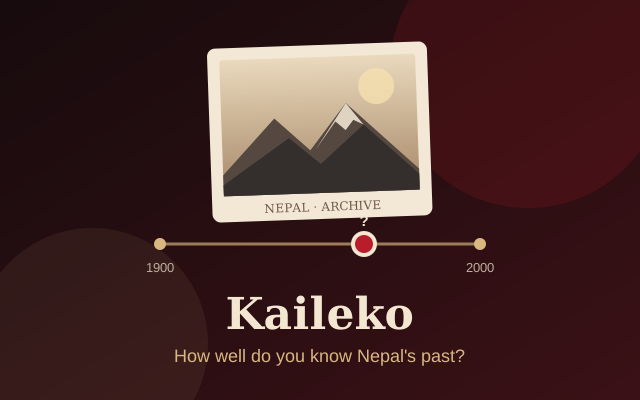
Kaileko (कहिलेको, meaning ‘from when?’) gave that learning a real product constraint. Players see a historical photograph from Nepal, guess when it was taken, and score points based on how close they are.
The product
Each game contains five rounds, with a daily challenge, scoring, player history and statistics, leaderboards, and authentication. The historical photos are in the public domain, with photographers attributed and credited.
Behind the player experience is an admin workflow for reviewing, publishing, and archiving photos. Curators can bulk-import CSV files or collect photos from URLs, but imports remain review-only: automation can prepare content without silently publishing it.
Architecture
Kaileko is a pnpm monorepo with a React and Vite client, a TypeScript and Express API, and shared contracts. MongoDB Atlas stores users, games, and photo metadata, while private Cloudflare R2 buckets hold the media itself.
The browser talks to the Vercel deployment through same-origin /api rewrites, which forward requests to the API on Render. Authorized media routes stream private R2 objects through the API rather than exposing storage credentials or relying on cross-origin signed redirects.
Authentication uses short-lived access tokens, rotating refresh tokens in secure cookies, CSRF protection, and role-based access control. Development, test, and production use separate databases and buckets so automated tests cannot mutate real or local working data.
Production engineering
The import pipeline is intentionally idempotent. Checksums and stable source identities prevent retries and restarted GitHub Actions jobs from duplicating media. URL collection is rate-limited, production runs are guarded, and dry runs validate manifests without writing anything.
Quality is layered across unit tests for scoring and domain rules, API integration tests, and Playwright end-to-end flows. Structured logs carry request IDs through failures while public error responses stay deliberately generic.
What production taught me
The most useful lessons came from failures that local happy paths missed. End-to-end cleanup once deleted development uploads, so test media moved into task-owned temporary directories. A signed R2 redirect returned 200, yet the browser could not consume its body cross-origin; proxying bytes through the API fixed the actual boundary instead of masking it.
Clean Render builds exposed workspace configuration and production dependency assumptions. Atlas enforced its own network boundary. Later, publication allowed a photo without historical context while the stored game snapshot still required it, causing production game creation to fail until both schemas expressed the same rule.
Each incident changed the design, not just the line that crashed: isolate environments, align validation across boundaries, keep imports repeatable, and log enough safe context to diagnose failures without leaking internals.
Outcome
Kaileko is a deployed full-stack product with a production API, private media infrastructure, secure administration, automated content workflows, and a tested player experience.
More importantly, it changed how I think about product engineering. I still care deeply about the interface, but now I also ask what happens on retry, who is authorized, which system owns the truth, how data survives a failure, and whether production can explain what went wrong.